Biblical Worldview Sites
Mission: America
World Magazine On-Line
Christianity Today
Josh Mcdowell
C. S. Lewis Apologetics

I will begin by stating that the Bible was never intended to be a science textbook, and I do not treat it as such. It claims to be an inspired, written revelation from God, using human authors to convey His purpose to mankind. Therefore, it is not the intent here to dig out Scripture texts and attempt to apply them scientifically to the Universe we live in. Rather, I want to discuss a couple of subjects related to science, from a point of view that you perhaps have not considered.
Many people think that there are irreconciliable conflicts between the Biblical text and what we have discovered about the world around us. One of the things I hope to show on this page is that some of the things we assume are true—in both Scripture and science—are not as absolutely proven as is commonly believed. Both theologians and scientists are human, and thus susceptible to human pride. Neither wants to give way before the other. And if there really is an Enemy who wishes to deceive us, then there are other, unseen factors involved as well. We have a tendency to assume that we have discovered all that is discoverable about any particular given subject, in spite of historical evidence to the contrary. So I encourage you to put aside your preconceptions and at least consider some of the things I am about to discuss here. I am not claiming to have all the answers, either. Just some ways of looking at things that many people may not have considered.
Afterward, I will point out some ways in which belief in One God has influenced the development of modern science. And finally, even though I said that the Bible is not a book on science, there are nevertheless some “interesting parallels”. So I will end by pointing out some of these parallels between aspects of the world around us and some verses found in Scripture.
Origins
One of the most misunderstood areas in the great Science vs. Theology debate is the question of origins. Ever since Lyell and Hutton came up with the concept of uniformitarianism, and Darwin came up with the idea of biological evolution, people on both sides of the aisle have tried to prove their position—and as a corollary, disprove the other side's position—using methods of scientific proof. The question of origins has been arbitrarily placed under the umbrella of science, and treated as such ever since.
The fact is, when you stop to think about it, origins is not science. Neither Darwinian evolution nor intelligent design fall into that category. Origins is history. Whatever took place happened in the past, and there is no demonstrable evidence of it being an ongoing process. Evolutionists argue that adaptations within species have been observed, and that is true, but is not proof. The heart of biological evolution, as stated in the title of Darwin's book, The Origin of Species, is change where new species arise, which has never been observed. Actually, intelligent design also predicts adaptability within species, but its primary tenet—the creation of individual species by an intelligent higher power—is also not observed today, nor can it be, if the Designer chooses not to cooperate in such research.
Naturalism (which includes biological evolution as well as non-biological natural processes to explain the world we live in) and intelligent design are both models. It is unfortunate that either of them is taken as scientific fact by their proponents. Just to make it clear, I do believe in intelligent design, but not because it is scientifically proven. I believe in it because the chain of reasoning on the Evidence page has brought me to the conclusion that the Bible is the Word of God, and therefore I simply accept the testimony of a “witness”, in the legal-historical sense. However, that does not mean that I believe in everything that creation “scientists” have claimed. Since origins is not science, their specific ideas are just as unproven as those of evolutionists.
Here are a few things for proponents of both models to stop and reconsider.
Unwarranted Assumptions of Naturalism
- Evolution is proven – As was pointed out above, origins is history, not science. It cannot be proven scientifically. Evolutionary theory is a model that purports to explain the origin of life and the diverse species. One can examine the world we live in—biology, fossils and so forth—and attempt to apply legal-historical methods to what exists, using it as evidence. However, intelligent design proponents are able to do the same thing. Nothing is proven, either way.
- The Earth is billions of years old – All dating methods are based on assumptions. If the assumptions are correct, then the ages arrived at are also correct. The assumptions may even make perfect sense—within the naturalistic model. But they depend upon naturalism being the correct model. We have a “chicken and the egg” situation here. The most reliable dating method, which is the speed-of-light and distant-astronomical-objects method, is actually based on observable physical law, i.e. that the speed of light is a constant. But it applies to the Universe as a whole, and cannot be used to give an age for the Earth itself.
- Only what we can measure actually exists – Naturalism often assumes that there is no supernatural, or anything else in the Universe beyond what we can detect with our senses or scientific instruments. It attempts to explain the Universe in terms of itself alone. The problem here is that we keep discovering new things. A couple of hundred years ago, the electron was unknown, along with the rest of the subatomic particle realm. One by one, these particles were discovered. Then came the neutrino, a (probably) massless particle without charge that is very difficult to detect. Over 65 billion of them pass through every square centimeter of the Earth's surface every second. But we do not see or feel them. And then there is dark matter, estimated to make up 85% of the mass of the Universe. So far, all attempts to detect it beyond its gravitational influence have failed. So what else is there that we not only have not detected, but probably have not even imagined?
Unwarranted Assumptions of Intelligent Design
- The Universe is only around 6000 years old – Believe it or not, this assumption comes from not reading the first chapter of Genesis literally. The first verse, “In the beginning, God created the heavens and the Earth” is clearly an introductory statement, with the rest of the account amplifying and providing details. If you read the following verses, “Now the Earth was formless and empty…” it is immedately clear, if you take it literally, that the Earth already existed, but not in the form that it exists today. The account does not say how long the planet had been in existence. And as for the sun, moon and stars, on the fourth day God said, “Let there be lights in the sky…” So did He create all of the heavenly bodies at that time, or did He make a change in the atmosphere so that bodies that were previously unseen became visible as lights in the sky? Either process satisfies the requirements of the verse, and the second option actually requires less contortion to make it fit into the rest of the account. (Note that the Genesis text still clearly states that life is a recent creation and did not arise naturally of itself.)
- The Second Law of Thermodynamics resulted from sin – The Second Law of Thermodynamics is derived from statistical mechanics, which describes the behavior of systems of large numbers of particles. It is part of the fundamental design of the Universe. The so-called “connection” is made where it says in Genesis 3 that God “cursed the Earth”. Actually, the curse was described in detail and applied specifically to the biological world, regarding food production, and had nothing to do with the nature of the greater overall Universe. Furthermore, the other so-called “connection” is taken from the statement that in the day humans ate of the Tree of Knowledge of Good and Evil, they would die. This applied only to humans. The actual command given in Genesis 2 uses the second person singular and was given only to Adam, not to everything else. Whatever happened to man happened to man, and not to all of nature.
- Jesus has to “hold” atomic nuclei together – This is actually a silly misreading of Colossians 1:17, where it says that “in him all things consist (‘cohere’, ‘hold together’).” Assuming any kind of scientific application to this verse, note the word “all”. The interpretation that Jesus has to hold atomic nuclei together personally assumes that, while he was able to come up with the electrical force to hold electrons in their orbitals, he somehow could not think of anything to hold like-charged protons together in the nucleus, so he has to “shore it up”. This is actually rather insulting to God's intelligence; if He could come up with the electrical force, He could also come up with the other well-documented nuclear forces. A more rational reading of this verse (and other similar verses) is that God sustains the existence of all laws, forces, particles, etc. that He designed into the Universe, and that because of that they continue to function as intended.
These are just a few examples. Being human, we tend to exaggerate our deductive and inductive reasoning powers and take basic ideas way beyond the point of sustainability. We think we have the answers. It takes humility to utter those three words: “I don't know.”
The Physical and the Spiritual
These are aspects of our world that have been debated as long as man has been on the face of the Earth. The physical is immediately tangible and observable. Science focuses on observing, classifying and explaining the physical world around us. It can be seen, felt and heard. Except for a few certifiable nut cases, no one denies its reality. We may debate its nature, but we all know that it exists.
The spiritual is another matter. The existence of beings and/or objects that can neither be seen nor felt nor otherwise observed has been an assumption of most cultures throughout history. Modern so-called “scientific” culture, on the other hand, tends to deny their existence, for the simple reason that they can neither be seen nor felt nor otherwise observed. I would like to point out a few things, however, that might give you reason to pause and re-think this question.
How Solid is the Physical?
You put your hand on a table. It does not go through. You make a fist and pound the table. Unless the table breaks, your hand still does not go through. The table—and your hand—appear to be solid. But what exactly is happening?
The fact is that the atoms that make up your hand and the table and everything else you see are mostly empty space. The nucleus is a tiny collection of particles at the center, surrounded by a cloud of electrons. Electrons are “point particles”, meaning that they either have no size, or that their size is so incredibly tiny that for all practical purposes it amounts to zero. Quantum mechanics shows us that the “cloud of electrons” surrounding the nucleus is merely a statistical wave set describing where the electrons might be at any given moment.
Normally, the negative charge of the electrons is exactly balanced by the positive charge of the protons in the nucleus, so that beyond a very short distance from the atom, there is no net electrical charge. No charge, no electrostatic force. However, when two atoms come very close together, such that the distance between the outer electrons in each is less than the distance to the nucleus, then the like charges (both negative) repel, and the effective force goes from zero to very strong in an incredibly short distance. This is what is happening when your hand approaches the table. When the atoms in your hand get within an atom's width of the atoms in the table, their outer electrons begin to “sense” one another, and a powerful repulsion results. This is the so-called “solidity” of matter.
And that is just the beginning. Neutrinos, as mentioned above, pass through our bodies unfelt and unseen by the hundreds of billions every second. Vision is merely the interaction of photons in a particular wavelength range with the atoms in the retina of your eye, causing the probability waves of electrons to jump to more energetic states and send signals through the optic nerve to your brain. On a macroscopic scale, the Universe appears solid and tangible. But on the subatomic scale, it is merely the interaction of particles that might be described as “ghostly”—about as substantial as what the “spiritual” is commonly assumed to be.
How Ghostly is the Spiritual?
Probably the best definition of “spirit” that I have ever heard—speaking in the metaphysical sense—is that it is everything that is not made up of the matter that makes up the so-called physical world, i.e. everything that is not electrons, quarks and particles clearly related to them (neutrinos are clearly related to electrons, and thus do not qualify as “spirit”). If you stop and think about it, this opens the door to almost unlimited possibilities.
The most popular view of spirit is that it is sort of a “ghostly ectoplasm”, or some sort of non-solid shape, kind of like a projection, that has no small-scale structure. In other words, the so-called physical universe is made up of tiny, organized building blocks, but the “spiritual universe”—often conceived as a “parallel universe”—is not. The truth is that there is no reason to assume that this is the case.
As I have mentioned elsewhere, astronomers estimate that up to 85% of the mass of the Universe is made up of so-called “dark matter”; something that has mass, but otherwise does not share any of the other properties of normal matter. Attempts to detect it other than by its gravitational influence have so far not succeeded.
How do we detect anything? We detect it by means of its interaction with our measuring equipment, whether that be a scientific instrument or just our “Mark One eyeball”. We see things visually and otherwise detect them electromagnetically because they emit photons, which are quanta of electromagnetic radiation. They emit photons because they have electrical charge. Electrons, on the other hand, are unaffected by the strong nuclear force, which only affects quarks. Neutrinos only interact via the so-called weak subatomic force, which is why they interact so little with matter. But they do interact and can be detected because they bear properties in common with ordinary matter.
Now what if the particles of dark matter have properties which are different than those of ordinary matter? What if they have “charge”, but it is not electrical or any of the equivalent properties of neutrinos or quarks?
In this case, it is easy to imagine dark matter particles interacting with one another, just as ordinary matter particles interact with each other, but in each case, not interacting with the other type of matter. And just as there are multiple types of ordinary matter particles that can be built up into nuclei and atoms and structures of ever-increasing complexity, why should we imagine that dark matter would only come in one “flavor”? Is it not more likely that there might be a whole family of particles, that can combine to form the analogues to nuclei and atoms and other structures, but made up of something that to us is completely invisible and insubstantial, because it does not interact with any of the charges or forces found in ordinary matter? For all we know, there may be many families of particles, all with their own sets of properties, and all potentially invisible to us and possibly even to one another between different families.
Taking it the next logical step, might there not be structures analogous to stars and planets; perhaps not the same, but existing according to whatever laws happen to govern the families of “dark” particles? For that matter, there could exist structures and phenomena that do not even have an analogy in our familiar material world.
Yes, this is basically just speculation. But dark matter has been observed to exist, due to its gravitational influence on ordinary matter. As for the rest, I am merely pointing out possibilities that those who doubt the existence of anything “spiritual” might not have thought of. No, I do not believe that God is made up of dark matter. If God is the creator and source of everything, then He is just as far beyond dark matter as He is beyond ordinary matter. He would be the creator and source of dark matter just as He is of regular matter. On the other hand, if there are intelligent beings that we commonly think of as “spirits”, such as angels and demons and similar creatures, that could be a completely different “matter”, if you will pardon the pun.
Heaven and the Heavens
In ancient times, people looked up at the sky and considered it the abode of God, or the gods, depending upon their particular beliefs. With the dawn of modern science and the ability to study objects in space, a division has taken place, where “the heavens” are considered to be a part of this world, while “Heaven” is something else, perhaps another dimension or realm beyond the familiar space-time continuum that we live in.
To that I ask: Why?
This is not to say that I believe that God is a part of this Universe, or that there cannot be anything beyond the familiar space-time realm that we know. Indeed, Paul wrote about being caught up to the “third heaven”. I am just saying that, given the possibilities discussed in the previous sections, the line between “the heavens” and “Heaven” may be more blurred than we imagine.
When Jesus rose from the dead, he appeared to his followers in physical form. He had a body that they could touch and feel. He ate and drank. Yet he clearly exhibited powers that he had not shown during his earthly life. He could appear in a room without going through any opening. He could disguise his appearance and become unrecognizable. And in the end, he rose bodily into the sky and vanished from sight. He had a solid, physical body, but it was probably no longer limited to ordinary matter.
Where is he?
I don't know, and neither does anyone else. He is described as being at “the right hand of God”. He still has the physical body that was raised from the dead, however. Given what we know—or rather, what we don't know—about much of what makes up the Universe, the possibilities are endless. How many “heavens” are there? One thing we have learned is that the variety of worlds merely made out of ordinary matter is greater than we ever imagined (see the page on extrasolar planets). Throw in the unimaginable possibilities of the unseen 85% of the Universe, and the possible varieties become mind-blowing.
And that is just in the Universe that we know of. Beyond that lie possibilities utterly unimaginable
The Influence of Monotheism on Science
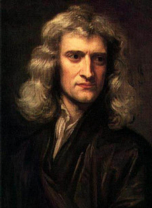
Sir Isaac Newton
For whatever reasons, primitive cultures tend to be polytheistic or animistic. The latter does not mean that they worship animals; rather, it is a belief that there is a separate spirit behind just about every phenomenon that exists, and that these spirits must be appeased or else disaster will follow. Without going into all the other consequences of such a belief system, I will point out here that it does not lend itself to scientific research, i.e. attempting to discover underlying order and structure to the world around us. This is because, according to these beliefs, everything happens according to the whim of the spirits or gods, and so there is no underlying order to things. It only seems that way because the spirits or gods are not having a bad hair day.
If God created man, then obviously we started off with a monotheistic belief, i.e. a belief in one supreme Being. For whatever reasons, over time that knowledge was lost, until by the time of Abraham it was quite rare. (Yes, many primitive cultures do believe in a creator God, but He is only one of many gods and spirits that they also believe have authority in the world.) The first truly monotheistic culture was Israel, after they came out of Egypt. But even they fell into idolatry and reduced God to merely one of many gods, and what monotheistic belief they clung to they did not export. It wasn't until the coming of Christianity that monotheism began to spread around the world.
Thus it was that when science began to take hold in Europe, it came into existence in a monotheistic culture, one that viewed the world as the creation of a single Deity who designed it to function according to a rational plan. So instead of just shrugging off the way things worked as the whim of the local tree spirit, they began to try and figure out how it all fit together as part of the larger plan. It was this concept that led to the beginning of true scientific research and the scientific method.
It is ironic that so many modern scientists use these very methods that came about because of belief in a rational creator to try and “prove” that He is unnecessary, and therefore nonexistent. And since in today's society scientists have been elevated almost to the level of “high priests”, when they say things like this, many take it as gospel truth. If I have one thing to say, it is to remind you that scientists are just as human as the rest of us. They are not infallible. In spite of claims to greater objectivity, they are just as influenced by personal beliefs and prejudices as you and I. So instead of just taking them at their word, I encourage you to think.
Some Interesting Scientific Tidbits
As I said, the Bible is not a book of science. Nevertheless, there are some interesting parallels…
- According to modern particle physics and quantum mechanics, as well as general relativity, the universe essentially consists of energy (matter is merely a form of energy) and laws to govern it. According to Scripture, God “upholds all things by His powerful word.”
- In Genesis 1, before God began creating the world, it was described as being dark and completely covered with water, with “waters above the firmament and waters below.” Recent models of planetary formation predict that Earth should have a dense atmosphere of mostly water vapor and carbon dioxide, with a thick, world-girdling cloud layer.
- Just about every culture in the world has a legend that is recognizably related to the Flood account in Genesis.
- In addition to this, geologists have discovered that every part of the surface of the Earth was at one time under water.
- The Bible declares that God exists from eternity past and that He knows the end from the beginning, i.e. He exists independent of time. Modern physics has demonstrated that space and time exist only as relationships between matter and energy; if matter and energy are created quantities, then so are space and time.
- A number of natural processes—the hydrological cycle, different types of stars, atmospheric circulation, the importance of blood to the body, and more—are recognizably described in layman's terms in various Biblical passages.
- The writer of Proverbs knew, thousands of years ago, that physical health is directly related to mental and spiritual health.