Basic Data
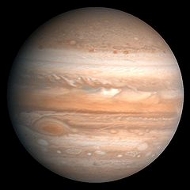
- Mean Distance from Sun: 778.5 million km.
- Equatorial Radius: 71,492 km. (11.21 Earth)
- Mass: 1.90 x 1027 kg. (317.8 Earth)
- Surface Gravity: 24.8 m/s2 (2.53 Earth)
- Length of Year: 11.86 years
- Length of Day: 9h 56m
Jupiter
Basic Data
Jupiter has been called the King of Planets. Some people suspect that there might have been some kind of “inspiration” that led the ancients to name this particular point of light after the chief of the gods. An immense ball of mostly hydrogen—similar in composition to a star—Jupiter does not have a solid surface. Instead, as one plunges into its atmosphere one finds himself descending through layers of gas of ever-increasing density, until one's spacecraft or probe is crushed beneath the weight. And far from being a frozen wasteland, Jupiter is hot. The Galileo probe reported rapidly rising temperatures—well above the boiling point of water—after penetrating only a little more than a hundred and fifty kilometers.
The first thing you will notice as you look at Jupiter are the colorful bands of clouds. These bands were once believed to merely be a “thin scum” at the top of the atmosphere. However, the Juno probe discovered that they extend down to nearly 3000 kilometers below the cloud tops, and actually contain nearly 1% of Jupiter's total mass. They are most likely composed of chemicals created by reactions deep within the planet and brought to the upper layers by convection, and by chemicals formed by reactions triggered by solar ultraviolet radiation striking the outermost layers of gas.
Because of the lack of a solid surface to disrupt weather patterns like on Earth, storms on Jupiter can last for a very long time. Probably the most famous storm in the Solar System is the Great Red Spot on Jupiter, which has been raging in the southern hemisphere of that planet ever since Galileo first observed it hundreds of years ago. It is larger than the entire planet Earth. Other storms have appeared, but none has lasted as long. At times the Great Red Spot has faded, later to return to its distinctive color again, but it has never disappeared entirely. Interestingly, in recent years several “white spot” storms merged into a single larger storm, which then proceeded to turn red. It has been dubbed “Red Spot Junior”. Only time will tell if it will end up as long-lived as its more famous cousin.
One of the most surprising recent discoveries, made by the Juno orbiter, is that the polar regions of Jupiter are basically blue, similar in color to Neptune. Large cyclonic storms hover over both poles, surrounded by arrays of smaller storms.
Jupiter has often been called “a star that failed”. Actually, in order to begin nuclear reactions in its core, Jupiter would have to be at least 50 times more massive than it is. Nevertheless, gravitational compression does generate enough energy so that the planet radiates more than twice the amount of energy that it receives from the Sun.
Jupiter is believed to have a core consisting of heavier elements, often dubbed a “rocky” core. Gravitational measurements in 1997 suggested a mass anywhere from 12 to 45 Earth masses for the core. Of course, such a core would not be simply a lump of rock, like a heavy Earth sitting in the middle of the planet. The tremendous pressure and temperature would cause the matter that it is composed of to enter states not found in milder environments such as Earth. At least part of Jupiter's core is believed to consist of degenerate matter, which is matter where the atoms have been crushed out of existence, and all that remains is a “fluid” of subatomic particles.
According to traditional theory, the heavier elements in Jupiter should have sunk to the center over time, thus leaving the core to be composed of heavier elements, and the surrounding immense atmosphere composed of lighter elements. However, more recent research suggests that convection deep within gas giant planets such as Jupiter may have “mixed up” the elements in the inner parts of these planets, thus eliminating any distinctive “rocky” core.
Other recent calculations suggest that the tremendous pressures inside large gas giants such as Jupiter and Saturn may have caused elemental carbon to crystallize into diamond. It is speculated that there may be “diamond-bergs” of various sizes floating deep inside the planet in a fluid hydrogen “sea”. Unfortunately, these diamonds, assuming that they exist, are far out of the reach of humanity, at least with our current level of technology.
Probably the deadliest aspect of Jupiter regarding the possibility of life among its moons is the planet's immense and powerful radiation belt. Vast quantities of charged particles, trapped in the biggest magnetic field in the solar system (except for the sun's own), produce a blizzard of particles that can kill very quickly. Even unmanned spacecraft have to be shielded in order for their electronics to survive.
Jupiter is also a strong source of radio emissions. These are related to the planet's powerful magnetic field, as well as thermal heating in the atmosphere.
Jupiter has many moons. Most of them are small, asteroid-like rocks, many of them probably captured from the asteroid belt itself. Four of the moons are large: Io, Europa, Ganymede and Callisto. These are called the “Galilean satellites” because they were discovered by Galileo when he observed Jupiter through his telescope. (They were the first solid evidence that not everything in the Universe revolves around the Earth.)
The realm of Jupiter is immense and magnificent. The heavens truly do declare the glory of God. But it is also a cold and poisonous realm, bombarded with lethal radiation. It is not a place for man.
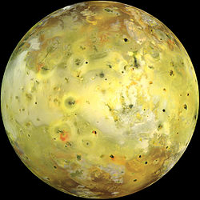
While most of the moons in the outer Solar System are largely ice, Io is a rocky body. This is probably because tidal flexing from its parent planet—Jupiter—as well as orbital resonance with two of the other Galilean satellites—Europa and Ganymede—have combined to heat it to the point where any icy material has long since vaporized and escaped. With over 400 active volcanoes, Io is also the most geologically active body in the Solar System. Sulfur and sulfur dioxide are abundant on the surface, and give the moon its distinctive yellow-orange color. The surface of Io changes more rapidly than the surface of any other body in the Solar System, mainly due to volcanic eruptions and lava flows.
Io has between 100 and 150 mountains, the tallest of which rise to over seventeen and a half kilometers. This makes them taller than any mountain on Earth. These mountains appear to be tectonic in nature (arising from movement and compression in the crustal layer), rather than volcanic. However, like the volcanic activity, they are probably related to the stresses from gravitational interaction with Jupiter and the other moons.
Interactions with Jupiter's powerful magnetosphere actually produce an electrical current flowing between Io and Jupiter's poles. This current—known as the Io flux tube—produces aurorae in Jupiter's polar regions, and also affects Jupiter's radio emissions.
Io has an extremely thin atmosphere composed of mostly sulfur dioxide, along with minor components, which varies in pressure depending on time of day, amount of local sulfur dioxide “frost”, volcanic activity and even latitude. Interaction with the flux tube produces aurorae in the polar latitudes of Io.
Io orbits Jupiter within a torus of plasma, which adds to the radiation level on its surface. In spite of this, Io's radiation level is not the highest among the Galilean satellites. Nevertheless, Io is still an extremely hostile environment for terrestrial life.
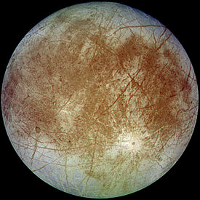
Europa is the smallest of the Galilean satellites. It is primarily composed of rocky material, but is covered with a layer of water ice. Europa has one of the smoothest surfaces in the Solar System, with very few craters, although the surface is marked by many cracks and streaks. This smoothness, along with tidal flexing from Jupiter and the other large moons, has led to the hypothesis that the surface ice covers a global ocean. The total surface layer is estimated to be around 100 km thick, but it is not known how much of this is frozen ice and how much is liquid water.
An induced magnetic field has been detected on Europa, which is consistent with the idea of a subsurface conductive layer, presumably of water laced with salt compounds. There is also evidence that the surface of Europa has shifted, which is consistent with the idea of a liquid layer. The two main competing theories are the “thin ice” theory, in which the surface ice layer is only a few kilometers deep, and the “thick ice” theory, in which the surface ice layer is much thicker, and the subsurface ocean lies much deeper.
Europa has a very thin atmosphere (less than a trillionth of the pressure here on Earth), consisting mostly of oxygen. This thin trace of gas is produced by dissociation of water molecules by radiation, both solar and from Jupiter's radiation belt. The hydrogen escapes, leaving the oxygen molecules behind.
There has long been speculation about the possibility of life in a Europan subsurface ocean. However, to date there is no possible way to either confirm or deny this hypothesis by direct observation. In addition, there are unanswered questions as to where such life would get its energy, as well as whether or not the chemical composition of such an ocean would prove to be too hostile to life. From what has been observed so far regarding icy bodies in the outer Solar System (mainly comets), they generally tend to be contaminated with toxic chemicals.
Europa's orbital period around Jupiter is exactly twice that of Io, and half that of Ganymede.
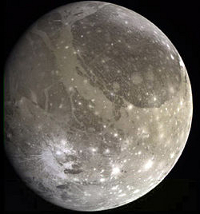
Ganymede is the largest moon in the solar system, slightly larger than Titan (see Saturn), and larger than the planet Mercury. It is composed of a largely differentiated mixture of rock and water ice. It is believed to have a salt water ocean a couple of hundred kilometers beneath the surface, which is primarily composed of water ice. There is evidence for a liquid iron core, similar to that of Earth.
Ganymede is the only moon in the Solar System with its own magnetic field, distinct from the magnetic field of its parent planet. This magnetic field is likely generated by convection within the liquid iron core.
Ganymede has a very thin atmosphere, composed mainly of atomic and molecular oxygen, with possible trace amounts of ozone. Hydrogen is a minor component as well. Like on Europa, this trace of atmosphere is believed to come from radiation splitting water molecules into hydrogen and oxygen.
The surface of Ganymede exhibits two basic types of terrain: ancient, highly cratered terrain, which is fairly dark, and younger, smoother, lighter terrain, marked with grooves and ridges. (The grooved terrain once led a scientist to comment that it looked as if a drunken plowman had been at work in parts of this moon.) Although the grooved terrain is believed to be tectonic in origin, formation theories require a source of heating that is still undetermined.
Ganymede's orbital period around Jupiter is exactly twice that of Europa, and four times that of Io.
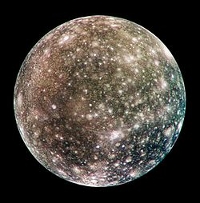
Callisto is similar in structure to Ganymede, but unlike its sister moon, does not exhibit any signs of tectonic activity. It is the most heavily cratered body in the Solar System. And since it is considerably further from Jupiter than Ganymede, it is not locked in any kind of resonance with the inner three large satellites. Also, unlike the other three large moons, the leading hemisphere (the hemisphere facing forward as it orbits Jupiter) is darker than the trailing hemisphere. For the other large moons, the opposite is true.
Callisto also has a very thin atmosphere. Unlike the atmospheres of Europa and Ganymede, Callisto's is composed of primarily carbon dioxide. The reason for CO2 is probably due to sublimation of CO2 ice in the crust. However, recent studies have suggested that there really is molecular oxygen present at Callisto as well—and in quantites considerably greater than that of CO2. But at the time of this article, there is no clear direct observational evidence.
There are several kinds of terrain on the surface of Callisto: cratered plains (which constitute the great majority of the surface area), light plains (believed to be composed of ice deposited by impact events), dark plains (very small, possibly cryovolcanic flows; “cryovolcanism” is volcanic action where the “lava” is not molten rock, but liquid water and other substances with low melting points), and multi-ring structures (very large impact craters where secondary fracturing produced a “ring” within the crater itself). Interestingly, in spite of the heavy cratering, there are very few small craters (less than 1 km in diameter). On a small scale, the surface is covered with what appear to be degraded crater remnants—knobs and pits. Many of the higher elevations—crater rims, knobs, ridges and the like; there are no mountains on Callisto— are covered with pure water ice and appear quite bright.
Internally, it appears that Callisto is not anywhere as completely differentiated as neighboring Ganymede. Observations of density and moment of inertia suggest a small silicate core, but not a liquid iron core which could generate a magnetic field. The majority of the interior is probably composed of a mixture of compressed rock and ices.
The remaining moons of Jupiter can be divided into two classes, the inner satellites of the Regular Group (which also includes the Galilean satellites), and the irregular satellites, which have wildly varying orbits and all of which lie outside the orbit of Callisto.
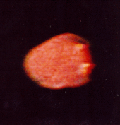
The inner satellites are also known as the Amalthea group, after their largest member, Amalthea, the fifth largest satellite of Jupiter. There are only four members; in order of distance from Jupiter they are Metis, Adrastea, Amalthea and Thebe. All circle Jupiter inside the orbit of Io, with periods of less than a day. These satellites also maintain Jupiter's faint ring system, and material from their surfaces ejected into space replenishes it. There are probably more yet-undiscovered small moons in this group, which also help maintain the ring system.
At the right you can see an image of Amalthea that was taken by Voyager 1 when it passed through the Jupiter system. As you can see, it is quite red. The reason for this color is not certain; one theory is that sulfur ejected from Io falls on the surface. Interestingly, closer observations have revealed bright patches of green on some of the major slopes of Amalthea. The source of this green coloration is still a mystery. (Due to the hostile environment of Amalthea, it is probably not vegetation!)
The irregular satellites can be divided into two main groups, the prograde group (i.e. those that orbit in the same direction as most bodies in the Solar System) and the retrograde group (those that orbit in reverse). Each group can be further subdivided into subgroups, based on similar orbital characterisitics and composition. Most, if not all, are probably captured asteroids. Many of the subgroups may have once been individual satellites that were shattered in collisions. Many have highly inclined orbits, i.e. they do not revolve around Jupiter in its equatorial plane.
At the time of this article, there are 59 known irregular satellites of Jupiter. More will no doubt be discovered in the future, as increasingly powerful instruments are pointed at the largest planet in our Solar System to study it and its retinue of moons.
Jupiter was known to the ancients, being one of the brightest objects in the night sky after the Moon and Venus. The Babylonians called it Marduk and the Greeks Zeus. It was one of the first objects in the sky that Galileo aimed his telescope at—and discovered the four satellites that bear his name and noted that they revolved around Jupiter instead of the Earth.
There has also been speculation that Jupiter's motion through the sky is directly related to the divisions in the Zodiac; there are twelve signs, and Jupiter's year is twelve of our years. Each year it moves from one sign to the next.
Jupiter's magnetic field is, of course, invisible. But if it were visible, it would loom four times as large as the Moon in our sky.
Jupiter has been visited by a number of probes. Most of them have been flybys, such as Pioneer and the two Voyagers. Only one, Galileo, was sent into orbit around the planet. It also released a probe that descended more than a hundred and fifty kilometers into the atmosphere before being destroyed by heat and pressure. In the end, mission controllers sent the Galileo orbiter crashing into Jupiter as well; they were afraid that it might someday crash on Europa and “contaminate” it.
Currently, the Juno probe is in a highly elliptical polar orbit around Jupiter. It is the first Jupiter probe to depend on solar cells for power, instead of a nuclear generator. After arriving in 2016, the original plan was to brake the orbiter into a closer orbit, but after issues came up with the spacecraft's engine, mission planners decided to leave it in the original orbit, rather than risk losing the spacecraft. The Juno mission is scheduled to continue until 2021, after which the probe will be flown into Jupiter's atmosphere and will burn up.
http://www.thebilliardpage.com/space/jupiter.shtml
Copyright © 2005-2026 William R. Penning. All rights reserved.