Basic Data
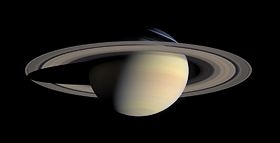
- Mean Distance from Sun: 1433.4 million km.
- Equatorial Radius: 60,268 km. (9.45 Earth)
- Mass: 5.68 x 1026 kg. (95.2 Earth)
- Surface Gravity: 9.0 m/s2 (0.91 Earth)
- Length of Year: 29.66 years
- Length of Day: 10h 32-47m
Saturn
Basic Data
If Jupiter is the king of planets, Saturn is certainly the most interesting. It is the only planet with a huge, highly developed ring system (the other gas giants have rings, but they are thin, small and faint). It has a number of interesting moons. And the planet itself boasts of its own mysteries. At twice the distance from the Sun as Jupiter, Saturn is a realm of ice. Many of its secrets were only revealed when spacecraft finally visited the planet. And although I would certainly never want to live there, Saturn is one of the places in the Solar System that I would most love to explore.
The first thing that strikes the observer is that the planet does not exhibit the clear, detailed cloud structure that Jupiter does. Saturn is more muted. But looks can be deceiving. Underneath the bland exterior, winds race at up to 1,800 kilometers per hour. The interior of Saturn is very hot, with core temperatures estimated to be over 11,700 degrees Celsius. Models of Saturn's structure predict that it has a rocky core anywhere from 9 to 22 times the mass of Earth. Like Jupiter, this core is surrounded by a layer of metallic hydrogen, then a layer of molecular hydrogen. The upper layer, considered the atmosphere proper, is at least a thousand kilometers thick.
The atmosphere of Saturn is mostly hydrogen, with a few percent helium. In addition, there are traces of other gases such as ammonia, acetylene, ethane, propane, phosphine and methane. The upper clouds are made up of ammonia crystals, with ammonium hydrosulfide and water clouds deeper below. Above the clouds is a layer of haze, which obscures their structure and results in the bland appearance. From time to time, enormous storms appear, usually at northern summer solstice. These storms can grow to encircle the entire planet, and have been observed to exhibit powerful lightning.
In addition to these periodic storms, both poles exhibit titanic hurricanes centered on the poles themselves. These hurricanes have immense eyewalls and smaller sub-storms inside. And the northern hurricane is surrounded by a gigantic hexagon, considerably larger than the Earth in diameter. Scientists are still unable to determine what causes this regular structure. There is evidence that it was already present when Voyager flew past Saturn, and was clearly observed by Cassini.
Saturn is the least dense of all the solar system's planets. As a result, in spite of being nearly a hundred times as massive as Earth, its surface gravity (more accurately, gravity at level of its atmosphere where the pressure is one bar, since it does not have a solid surface) is actually less than ours. Saturn is also the most “flattened” of all the planets, with a polar radius nearly 6000 kilometers less than its equatorial radius.
Saturn does possess a magnetic field, although it is much smaller than Jupiter's. In fact, it is actually slightly weaker than Earth's magnetic field. The solar wind (outflow of particles from the Sun) affects the size of the magnetic field considerably.
The rings of Saturn are without a doubt its most famous feature. When Galileo first looked at Saturn through a telescope, he thought that the planet was composed of three separate bodies, side by side. He also described the planet as “having ears”. When he looked at them later, when Saturn was at equinox and the rings were edge on, he wondered if Saturn had “swallowed his children”. It was Christiaan Huygens, the Dutch astronomer who also discovered the large moon Titan, that first proposed that the unusual structure was a ring around the planet.
Astrophysicists later on determined that such a ring could not be solid, and that it was probably composed of individual small chunks all orbiting the planet together. When the first space probes arrived at Saturn, this was confirmed. Indeed, when Voyager 1 arrived, with its higher resolution cameras, astronomers were surprised to discover that there weren't merely a few discrete rings, but rather, thousands, like grooves in a phonograph record. They are quite thin, varying from as little as 10 meters up to a kilometer in thickness. The individual chunks are anywhere from a centimeter or so in size up to 10 meters, and are composed of nearly pure water ice, with traces of impurities. Recent observations suggest that the ring chunks form dynamic clumps, which break apart and the components re-aggregate into new clumps.
Within the ring structure are many gaps. Observations have shown that these gaps are caused by gravitational orbital resonances with various moons of Saturn. The rings themselves begin at a little less than 7,000 kilometers above the planet's cloud tops, and extend out hundreds of thousands of kilometers, although the bright, visible parts only extend out some 70,000 kilometers. The main sections of the rings are given letter designations, with the A, B, and C rings being the most prominent. The faint E ring orbits at the same distance as the mid-size moon Enceladus (see below), and is fed by geyser-like eruptions from that moon.
When Voyager flew past Saturn, scientists were surprised to see what looked like “spokes” in the rings, which did not break up as would be expected from the inner ring sections orbiting faster than the outer sections. Instead the “spokes” moved as a unit. Later on, it was determined that they rotate almost synchronously with Saturn's magnetic field, suggesting a connection. There are various theories, including the possibility of electrically charged dust particles in the rings that are suspended away from the main ring material, but at this time no one is completely sure of their physical nature. They do appear to be seasonal, disappearing when Saturn is at midwinter or midsummer, and reappearing when the planet is closer to equinox.
The question of how the rings are maintained, when theory indicated that they should gradually dissipate and fall into Saturn, appeared to be at least partly answered when a number of small moonlets were found, orbiting near and among the rings. These moonlets, which have more stable orbits than the ring particles themselves, act as “shepherds”, keeping the particles in place. Similar shepherd moons have also been found among the sparser ring systems of the other gas giants.
One curious side effect that the rings have on some of these moons is the accumulation of large amounts of material on their equators, resulting in bodies that resemble flying saucers.
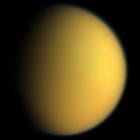
Titan is Saturn's largest moon, and the second largest moon in the solar system, larger than the planet Mercury. Like all of the large and medium-sized moons in the solar system, and the majority of smaller, irregular satellites as well, it is phase-locked, meaning that it rotates once per revolution around its parent planet, thus keeping the same face toward Saturn at all times. It was discovered in March of 1655 by Christiaan Huygens, the same astronomer who figured out the true structure of the rings. It was Galileo's discovery of Jupiter's 4 large satellites, 45 years earlier, that inspired Huygens to look for moons of Saturn.
The core of Titan is estimated to be around two-thirds of the total diameter of the moon, and to be rocky. Surrounding the core are layers of high-pressure ice in forms not found on Earth, a probable liquid layer composed of water and ammonia, and finally the crust, which is basically water ice. Observations of the position of surface features on Titan show a shift of up to 30 kilometers in less than 2 years, which supports the idea of a liquid layer; the rocky core, making up the large majority of the moon's mass, would remain phase-locked to Saturn, while the surface layer, if detached from the core by a liquid layer, would be free to “slide”.
Titan is the only moon in the Solar System to have a dense atmosphere. Surface air pressure is 1.6 times that of Earth, roughly equivalent to the pressure at the bottom of an Olympic class swimming pool. This atmosphere is composed mostly of nitrogen, with a few percent methane and traces of other gases such as hydrogen, ethane, acetylene, propane, hydrogen cyanide and more. The moon's orange color is caused by what is essentially “world-wide smog from Hell”, a haze of hydrocarbons and other semi-organic chemicals. This haze is the result of breakdown and recombination of molecules by ultraviolet light. Heavier components actually “snow” out of the atmosphere and coat the surface.
Because of the temperature, methane and ethane can exist in both liquid and gaseous states, and serve a function similar to that of water on Earth. Clouds composed mostly of these two hydrocarbons are scattered and variable, with heavier concentrations in the polar regions. Occasionally, quick and temporary buildups will take place in middle latitudes. These clouds rain liquid methane and ethane on the surface, creating temporary rivers similar to those found in deserts on Earth, and washing the particulate “snow” down to lower elevations, leaving higher elevations mostly bare ice. The more permanent clouds found near the poles create long lasting seas and lakes of liquid hydrocarbons, which to date are mostly found near the northern pole, with only a couple near the south pole. As the Saturnian system—including Titan—moves into northern spring and summer, scientists are watching to see if the majority of seas and lakes switches from the north to the south, i.e. if the distribution is seasonal, or if it is a more permanent feature of Titan's climate.
At one time, observations suggested that these seas and lakes were either very shallow, or else “sludgy”, choked with hydrocarbon “snow” which fell out of the sky. However, at least one northern sea, Ligeia Mare, has been determined to be 170 meters deep. This contrasts with measurements for Ontario Lacus, near the south pole, which is estimated to have a maximum depth of less than 8 meters. There is still need for plenty of observation to help fully resolve this question.
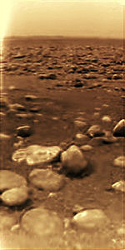
Surface of Titan
The equatorial regions are covered in vast “seas” of sand composed of grains of water ice coated with the hydrocarbon “snow”. Prevailing winds caused by tidal forces from Saturn have created huge, parallel dunes that extend for hundreds of kilometers east and west, except where they curve around surface features such as icy highlands or the very occasional impact crater. These dunes are similar in appearance to dunes found in deserts here on Earth. Similar dunes have been seen on Mars and even Venus, and are probably to be found on any world with an atmosphere and whatever equivalent of fine sand might be found there.
On January 14, 2005, the Huygens probe—appropriately named after the discoverer of Titan—parachuted through the atmosphere and landed in what appears to be a dry riverbed. On its way down, it snapped hundreds of pictures, showing icy, eroded highlands and dark, hydrocarbon-covered lowlands. Scattered clouds can be seen. The riverbed is strewn with rounded, eroded rocks made of ice. The sky is hidden behind an orange haze; an observer on the surface would never see either the Sun or Saturn. Total illumination is only about one ten-thousandth of what it is on Earth; Saturn only receives about a hundredth of the illumination as Earth because of its distance from the Sun, and the hydrocarbon haze further reduces the light reaching the surface to only about 1% of what it is at the top of the atmosphere. One scientist compared photographing the surface of TItan to “taking pictures of asphalt at dusk”.
Saturn possesses six intermediate-sized moons, all basically differentiated icy bodies with rocky cores of varying sizes and outer layers of water ice. These moons are listed in the following table.
| Name | Distance | Radius | Mass | Period |
| Mimas | 185,000 km | 198 km | 3.7 x 10¹⁹ kg | 0.9 days |
| Enceladus | 238,000 km | 252 km | 1.1 x 10²⁰ kg | 1.4 days |
| Tethys | 295,000 km | 531 km | 6.2 x 10²⁰ kg | 1.9 days |
| Dione | 377,000 km | 562 km | 1.1 x 10²¹ kg | 2.7 days |
| Rhea | 527,000 km | 764 km | 2.3 x 10²¹ kg | 4.5 days |
| Iapetus | 3,560,000 km | 735 km | 1.8 x 10²¹ kg | 79.3 days |
Mimas is the smallest of the intermediate-sized moons, and is noticeably flattened. Its most prominent feature is the crater Herschel, which is a third the diameter of the moon itself. When this crater was first seen by Voyager 1, on of the mission scientists was reported to have commented, “Well, looks like we found the Death Star…” Mimas has no known geologic activity, and its surface is dominated by impact craters.
Enceladus is the smallest body in the Solar System known to be geologically active. Fissures near the south pole spew forth water vapor and dust, which replenishes the faint E ring and is the main source of ions in Saturn's magnetosphere. The surface of Enceladus has remarkably few craters, although there are some areas that are more heavily cratered. From space, much of the surface appears quite smooth. However, close-up images reveal an incredibly rugged terrain, covered with wrinkles and house-sized boulders.
Because of the south polar geysers, it is theorized that Enceladus may have a liquid water ocean underneath its surface. For a body as small as it is, this is highly unusual. It is postulated that a 2 to 1 orbital resonance with the moon Dione may flex Enceladus sufficiently so as to warm up its interior.
Tethys is the fifth largest of Saturn's moons. Like Mimas, it possesses a huge impact crater, called Odysseus. Most of the surface of this geologically inactive moon is made up of hilly, cratered terrain. There is a vast canyon system extending at least three-quarters of the way around Tethys, which is geometrically concentric with the Odysseus impact basin, and may have been formed by the same event.
Dione is the fourth largest of Saturn's moons, and is mostly covered with craters. However, there are networks of troughs and lines (especially prominent on the trailing hemisphere, where they appeared to Voyager's less sophisticated cameras as “wispy terrain”), indicating that it once may have experienced tectonic activity. It is possibly still geologically active; there is evidence of past cryovolcanism in a couple of places. Again, this may be related to the 2 to 1 orbital resonance with Enceladus.
Rhea is the second largest of Saturn's moons. Like the other moons, its surface is heavily cratered. It appears to be geologically dead, at least at the present time. At one time, observations by the Cassini orbiter suggested the possible presence of a faint ring, which would have made Rhea the only moon in the Solar System with such an artifact. Subsequent observations failed to support this, and at this point there is no actual evidence of a ring system around Rhea. Interestingly enough, though, there is a faint “line” of material along the equator that could have been deposited there by an earlier ring when its orbit decayed due to interactions among the particles it was made of and fell to the surface.
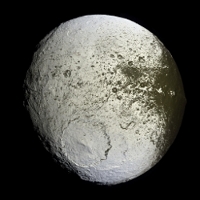
Iapetus
Iapetus is the “odd man out” among the mid-sized moons of Saturn. It is the only one that orbits beyond Titan. When it was first observed, it was noted that this moon was six times as bright on the trailing hemisphere as on the leading hemisphere. This notable asymmetry played a major role in Arthur Clarke's novel 2001: A Space Odyssey (even though they left this part out of the movie). When Cassini finally arrived in orbit around Saturn, a close flyby of Iapetus revealed that the leading hemisphere is covered in some kind of dark material. This material remained a mystery for some time, but in 2009 a clue was found when the Spitzer space telescope found a vast ring of dark material just inside the orbit of the outer, irregular moon Phoebe. Like Phoebe, this ring has a retrograde orbit, and is probably composed of material ejected from Phoebe by meteor impacts. Because of the retrograde orbit, these particles collide with the leading hemisphere of Iapetus, darkening it. While these deposits are not sufficient to explain the strong asymmetry, models show that a type of feedback would be set up, where ice would evaporate from the darker hemisphere and be deposited on the lighter hemisphere, thus accentuating the difference.
In addition to the dark coating on its leading hemisphere, Iapetus also has an extremely high equatorial ridge, reaching up to 20 kilometers in elevation, extending around nearly the entire equator. To an astronaut standing on the surface, this ridge would appear to be quite an impressive mountain range!
Saturn has a number of interesting small moons. The largest of these moons is Hyperion, which is sometimes classed along with the intermediate moons because of its size, but is irregular in shape. In addition, it is one of the few moons whose rotation is not phase-locked to its planet, and furthermore, its rotation is chaotic, meaning that it does not have a well-defined rotational axis. It essentially “tumbles” around in its orbit. It has a very low density and may contain many hollow spaces within. It is in a 4 to 3 orbital resonance with Titan.
Janus and Epimetheus are a pair of moons which nearly share the same orbit. At any given time, one of them orbits a few kilometers further from Saturn than the other, and thus moves slightly slower. You would think that this would lead to collisions, given that both are over a hundred kilometers in diameter. But what happens is that gravitational interactions cause the outer moon to speed up and move down toward Saturn, essentially replacing the inner moon, while the inner moon is slowed down and moves outward. In effect, the two moons exchange orbits whenever they come near to one another.
Another type of moon unique to the Saturn system is the so-called “Trojan moon”, which is a small moon sharing the orbit of a larger moon, either 60 degrees ahead or 60 degrees behind. This forms an equilateral triangle with the main moon, the Trojan moon and Saturn being at the vertices. This has long been recognized to be a stable configuration; if a moon in one of these Trojan points starts to drift out of position for whatever reason—meteor impact, for example—the combined gravitational forces of the main moon and Saturn will pull it back into the Trojan position. Tethys and Dione each have two Trojan moons associated with them, one leading and one trailing in each case.
Ring shepherd moon are small moons which help maintain the ring system structure. See the section above on the rings for more details.
Three more small moons orbit between Mimas and Enceladus, and are associated with faint ring arcs (incomplete rings), and in one case, a complete faint ring.
Saturn also possesses a number of irregular moons which orbit out well beyond Iapetus. They are clumped into three main groups, two of which orbit prograde, and one which orbits retrograde. These group are the Inuit Group, with 5 prograde moons, the Gallic Group, with 4 prograde moons, and the Norse Group, with 29 retrograde moons. The largest member by far of these groups is Phoebe, which is in the Norse Group. As mentioned in the previous section on Intermediate Moons, it is believed to be the source of a diffuse ring of very dark material which may be responsible for the dark leading face of Iapetus. Phoebe is composed of mainly water ice, plus carbon dioxide and other materials, some of which are organic in nature. It is believed to have originally been a member of the Kuiper Belt (see Trans-Neptunian Objects) whose orbit was perturbed by interactions with other Belt members and thus wandered inward and was captured by Saturn.
Saturn is the last planet that was known to ancients. The Greeks called it Kronos and the Babylonians knew it as Ninurta. The ancient Hebrews called it Shabbathai.
With the development of the telescope, details of the planet were swiftly discovered; the rings, moons and the flattening of the poles. Over the centuries, astronomers continued to study Saturn with increasingly powerful telescopes and instruments. It remained a favorite among fiction writers and space artists. Nevertheless, being around a billion and a half kilometers away, it wasn't until space probes arrived at Saturn that many of its secrets began to be revealed.
Even today, after several visits by spacecraft, Saturn remains a favorite for telescope viewers.
Three spacecraft (Pioneer and both Voyagers) have made flybys of Saturn. In addition, the Cassini probe entered orbit on July 1, 2004, and after releasing the Huygens probe on December 25 of the same year, continued to orbit Saturn until September 15, 2017, when it entered Saturn's atmosphere and burned up. During its more than thirteen years in orbit, it made many flybys of many of Saturn's moons, and sent back data which at the time of this article is still being analyzed.
Several other missions have been proposed, including various types of landers or balloons for exploring Titan. However, at this point none have been approved.
http://www.thebilliardpage.com/space/saturn.shtml
Copyright © 2005-2026 William R. Penning. All rights reserved.