Basic Data
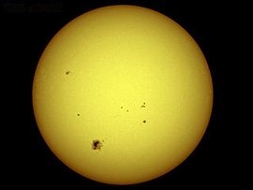
- Equatorial Radius: 695,500 km. (109 Earth)
- Mass: 1.99 x 1030 kg. (332,946 Earth)
- Surface Gravity: 274.0 m/s2 (27.94 Earth)
- Surface Temperature: 5500° C
- Spectral Type: G2
The Sun
Basic Data
No tour of the solar system would be complete without its main member. Making up 98.6% of its total mass, the Sun provides heat and light to all of the planets and other objects orbiting it. Yet the Sun is merely an average star in our galaxy of over two hundred billion stars. Only its nearness to us makes it important.
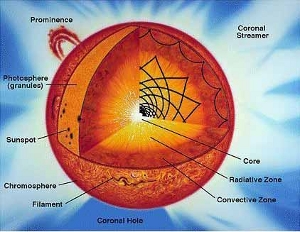
The Sun is composed mostly of hydrogen and helium, and can be divided into distinct regions. The innermost region, the core, extends outward from the center to about 20% of the Sun's total radius. The density of core material is around 150 times that of water, under tremendous pressure and at a temperature of over 13.6 million degrees C. It is in the core that nuclear fusion converts hydrogen into helium, thus providing the energy that the Sun ultimately radiates.
Outward from the core to a point around 70% of the total solar radius is the radiative zone, where energy is transferred by radiation. From the edge of the radiative zone to the solar surface lies the convective zone, where huge cells of gas rise from the depths carrying energy outward, and similar cells sink back, depleted of their heat. These convective cells account for the granular appearance of the solar surface.
Above the “surface” is the solar atmosphere. Tenuous outer layers—a high vacuum by Earth standards—actually extend out to the outer solar system. The so-called “solar wind” is made up of material ejected from the Sun and "blown" outward.
The Sun has a strong magnetic field. Because the Sun is not a solid body, and because different parts rotate at different rates, the magnetic field becomes very twisted. Often, huge loops of magnetic flux “pop” out into space, leaving localized spots of high field strength in pairs on the surface. These spots are cooler than the rest of the surface and appear darker, and are called “sunspots”. Sections of the magnetic field can also recombine, releasing tremendous amounts of energy into the solar corona (a part of the Sun's outer atmosphere). This results in a solar flare, which can release large amounts of radiation. When this radiation hits the Earth, it can result in increased aurora activity and even damage to electrical power grids. It can also be a hazard to astronauts in orbit.
The energy output from the Sun is slightly variable. First, there is an eleven-year cycle related to sunspots and the magnetic field. When the sun is active—i.e. with many sunspots and high solar flare activity—the Sun is actually slightly hotter. Conversely, during solar minimum, when sunspots vanish and flare activity drops, it is slightly cooler. Normally, we do not really notice the effect on climate because the difference is minimal. However, the Sun also goes through periods when activity ceases altogether, such as the so-called “Maunder Minimum”, which lasted from around 1645 to 1715. That period coincided with the “Little Ice Age”, during which worldwide temperatures were lower than normal. Other periods of reduced solar activity also appear to be tied to global temperature reduction.
The ancients believed that the Sun revolved around the Earth. It wasn't until the time of Galileo that scientists began to realize that the Earth—and the other planets—revolved around the Sun instead. The new assumption was that the Sun was the center of the Universe and that everything revolved around it. Later, when astronomers realized that the stars were in reality other suns, and when they discovered the nature and structure of the Milky Way galaxy, they recognized that the Sun really does move, in orbit around the center of the galaxy. It takes around 250 million years to complete one revolution.
As a source of energy for eternity, the Sun is not actually reliable. As it fuses hydrogen into helium in its core, the hydrogen is used up. Eventually, there will come a time when the amount of hydrogen available for fusion runs out. At that point, the core will begin to collapse, which will actually release even more energy, causing the rest of the sun to expand tremendously into a red giant. Ultimately, the red giant will disperse due to thermal pulsations in the remnant core, until nothing but the core is left. This core, now called a white dwarf star, will continue to gradually cool until someday it gradually fades into a cinder. However, this will take another 4.5 to 5 billion years to happen.

McMath Solar Telescope, Kitt Peak
In a way, the title of this section almost sounds ridiculous. The Sun is the biggest single fact up in the sky, provides all the heat and light that make our world habitable, defines day and night, winter and summer, etc. But it was only in recent centuries that man began to seriously study our local star scientifically.
Many ancient cultures worshipped the Sun. Many others associated a god with it. In a way, this is understandable, since if the Sun were to vanish, life would quickly follow. Nevertheless, it was the ancient Hebrews who got it right when they chose to worship the Creator, rather than the creation. For all its immensity and power, the Sun is not God.
The Sun has been studied extensively from Earth throughout the history of modern astronomy. Unlike standard telescopes, where instruments (including human eyeballs) peer directly through the optics, solar telescopes often project an image of the Sun for study. And when instruments are directly attached, heavy filters are used to cut the light levels down to avoid damage. Never look directly at the Sun. Eye damage can result.
Since the dawn of the space age, many satellites have been launched to observe the Sun. Most of these have operated from Earth orbit, although a number have been sent into various orbits around the Sun itself. Because of the extreme heat, no probe can actually enter or attempt to “land” on the Sun directly (until and unless we develop technology far in advance of anything we have today!). However, this has not prevented NASA from sending the Parker Solar Probe into an orbit which carries it very close to the sun, less than four million miles from the “surface”. The Parker probe is expected to remain in this orbit until at least 2025, carrying out observations not only of the Sun itself, but of the corona, which it is actually inside.
Another interesting solar probe was Ulysses, which was first sent out to Jupiter in order to be slingshot into a polar orbit around the Sun.
http://www.thebilliardpage.com/space/sun.shtml
Copyright © 2005-2026 William R. Penning. All rights reserved.