Basic Data
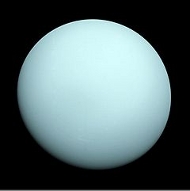
- Mean Distance from Sun: 2876.7 million km.
- Equatorial Radius: 25,559 km. (4.01 Earth)
- Mass: 8.68 x 1025 kg. (14.5 Earth)
- Surface Gravity: 8.7 m/s2 (0.87 Earth)
- Length of Year: 84.32 years
- Length of Day: 17h 14m
Uranus
Basic Data
One of the more humorous issues with this planet is the pronunciation of its name. For decades there has been a running debate over whether you say “your anus” or “urine us”. Either one can bring snickers from an audience of the unsophisticated. Suffice it to say that I am not going to address that question here. As you read this page, pronounce it however you like. This is a visual/textual medium, not audio. You are on your own.
Uranus was the first planet discovered in modern times. All of the previous ones were known to ancients. Orbiting twice the distance from the Sun as Saturn, it receives only a fourth of the sunlight, and is smaller, so it has less reflecting area. The result is that it is enough dimmer that it remained undiscovered throughout most of human history, until instruments were developed to make its discovery possible.
Unlike Jupiter and Saturn, Uranus is blue-green in color. This is because its atmosphere—although still mostly hydrogen and helium—contains a higher percentage of methane and other hydrocarbons than either of the two larger gas giants. Internally, it is believed that the rocky core of Uranus is actually less massive than the planet Earth, but that it is surrounded by a mantle composed of “ice” with more than 13 times the mass of Earth. This “ice” is probably liquid rather than solid, and is composed largely of water and ammonia, along with other volatile substances. Nor is it cold; only tremendous pressure keeps it from flashing into steam. Recent calculations suggest that there may be a layer of carbon that has been compressed into liquid diamond.
Because of the smaller size, as well as the presence of larger quantities of heavier elements than the large gas giants, Uranus and Neptune are also called “ice giants”. In extrasolar planet research, gas giants (Jovians) and ice giants (Neptunians) are two of the three main categories of planets larger than Earth.
Uranus is also odd in one very particular way; it is tipped over on its side. The rotational pole is tilted at more than 90 degrees. When Voyager 2 passed by in 1986, the south pole was pointed almost directly at the sun. The planet's moons and faint rings also lie in equatorial orbits, which made the entire system resemble a target with a bullseye to the approaching space probe.
Before Voyager 2 arrived, Uranus was known to have five moons: Miranda, Ariel, Umbriel, Titania and Oberon. Between Voyager and the Hubble Space Telescope, 22 more have been discovered to date.
At the time of this article, Uranus has 27 known moons, all of which are named after characters from the works of William Shakespeare and Alexander Pope. The first two, Titania and Oberon, were discovered by William Herschel, the discoverer of Uranus itself. Altogether, there are 5 intermediate-sized moons, which are listed in the following table, plus 22 smaller, irregular ones.
Actual data on all of these moons is relatively sparse, since only one space probe has visited Uranus. Only one side of each of them has actually been imaged from relatively close up.
| Name | Distance | Radius | Mass | Period |
| Miranda | 129,390 km | 236 km | 6.6 x 10¹⁹ kg | 1.4 days |
| Ariel | 191,020 km | 579 km | 1.4 x 10²¹ kg | 2.5 days |
| Umbriel | 266,300 km | 585 km | 1.2 x 10²¹ kg | 4.1 days |
| Titania | 435,910 km | 788 km | 3.5 x 10²¹ kg | 8.7 days |
| Oberon | 583,520 km | 761 km | 3.0 x 10²¹ kg | 13.5 days |
Miranda is the closest of the 5, as well as the smallest. It is also the one whose composition has the highest percentage of ice, though this ice is not pure water, but probably includes frozen ammonia and carbon dioxide. Although spherical, it has a very irregular, patchwork surface, criss-crossed by huge canyons. Models to explain its appearance include cryovolcanism (volcanoes which spew liquid water mixtures instead of molten rock), as well as tidal flexing from Uranus and possible past 3-to-1 orbital resonance with Umbriel.
Another theory, proposed shortly after the Voyager 2 flyby, is that an earlier “version” of Miranda was shattered by impact with another large body, and that the pieces re-coalesced into the present moon.
Ariel is the most reflective of all of Uranus' moons. Large areas of its surface consist of relatively smooth plains and regions criss-crossed with canyons, which are very lightly cratered. Most of the heavily cratered areas are found near the south pole. This moon is estimated to be composed of about 50% water ice, plus impurities, and 50% rocky material, and is differentiated, with the rocky material forming the core and the icy portion the surrounding mantle and surface. Carbon dioxide has been detected on the surface, but given the temperature of Ariel, it is frozen.
The darkest of the 5 intermediate moons is Umbriel. Its surface is covered in impact craters. Interestingly, the surface is actually slightly blue, though there is evidence that the leading hemisphere may be somewhat redder. Umbriel is differentiated, with a rocky core and outer portion made up of water ice. Like Ariel, the only substance positively identified on its surface besides water ice is carbon dioxide. Also, like Ariel, the CO2 is frozen, not gaseous.
The most prominent feature on Umbriel is the crater Wunda, with a diameter of around 131 kilometers. It has a ring of bright material on its floor (which is even bluer than the rest of the surface).
The largest of Uranus' moons is Titania, which is just a bit bigger than Saturn's moon Rhea. It is composed of roughly equal parts water ice and rock, and differentiated into a rocky core and an icy mantle. There may be a layer of liquid water at the boundary between the mantle ice and the core rock. Like Ariel and Umbriel, the only compound actually detected on its surface besides water is carbon dioxide. Interestingly, its surface color tends just the opposite of of Umbriel. Where Umbriel is slightly blue in color, Titania is slightly red. Although the surface is cratered, it is less heavily cratered than some of the other moons of Uranus. Some of the craters are surrounded by bright ejected material, indicating that they are relatively young. A number of enormous, intersecting faults criss-cross parts of the surface.
The outermost of the intermediate satellites is Oberon, which is also the second largest moon of Uranus. It is essentially a smaller version of Titania, similar in structure, and surface features. Also like Titania, it has a slightly reddish color, and is the reddest of Uranus' moons. It is also the most heavily cratered.
The remaining moons of Uranus, all of them much smaller than Miranda, can be divided into two groups. The first group is the Inner Group, of which there are 13 at the time of this article. All of them lie inside the orbit of Miranda and are associated with the faint ring system of Uranus. In fact, the rings themselves may be fragments left over from one or more additional inner moons that collided at some time in the past. These small moons do not have stable orbits and are constantly perturbing one another, which probably results in collisions. All have dark surfaces, and are probably chunks of water ice contaminated by some kind of organic material that has been altered by radiation. At least one faint ring is being fed particles from one of the outermost of these inner moons.
The remaining 9 satellites make up the Irregular Group. All of them orbit well beyond Oberon, the outermost of the intermediate moons. Eight of these moons orbit backwards, with only one, Margaret, orbiting in the normal prograde direction. Half of the retrograde moons—the ones closest to Uranus—have orbits of low eccentricity, i.e. they are closer to circular, while the outer four are highly eccentric. All 9 are believed to be captured objects.
Uranus was the first planet discovered by telescope, since it is very faint. Actually, it is visible to the naked eye under good conditions, and can be easily seen in a pair of binoculars. However, due to its slow motion across the sky and the fact that it does not stand out against the background, its true nature was not recognized until William Herschel observed it in the late 18th century. Even then, he thought at first that it was a comet, and it wasn't until several other astronomers began to suspect that it was a planet that he changed his mind.
Since its discovery, Uranus has been extensively studied using telescopes, and in recent decades, observed through the Hubble Space Telescope and visited by a flyby space probe.
Voyager 2 is the only probe to have visited Uranus so far. At this time, no other probes are yet planned. Maybe someday…
http://www.thebilliardpage.com/space/uranus.shtml
Copyright © 2005-2026 William R. Penning. All rights reserved.