Basic Data
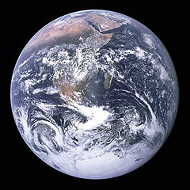
- Mean Distance from Sun: 149.6 million km.
- Equatorial Radius: 6378 km.
- Mass: 5.97 x 1024 kg.
- Surface Gravity: 9.8 m/s2
- Length of Year: 365.3 days
- Length of Day: 23h 56m
- Surface Air Pressure: 101.3 kPa
Earth
Basic Data
Our home world rightly deserves an entire page all its own—or more. Everything associated with human history since the beginning of mankind has taken place on what is often called this “small blue planet”. Actually, Earth is the largest planet in the solar system that has a solid surface; only the four gas giants are larger. Similarly, terrestrial gravity is higher than on any other solid body in the solar system.
While Earth does have a solid surface, 3/4 of that surface is covered in liquid water. Most of this water is found in oceans and seas and is chemically impure, containing a high concentration of salt compounds. The rest is in rivers and other bodies of water (usually flowing) on the continents that make up the remaining quarter of the surface.
Earth has an atmosphere made up mostly of nitrogen (78%), with an appreciable fraction of oxygen in addition (21%). Trace gases—including as argon, water vapor, carbon dioxide and a few others—make up the remaining 1%. Earth is the only planet currently known to have more than the barest trace of oxygen in its atmosphere; any appreciable fraction of oxygen is actually unstable without some means of replenishing it, since the gas is highly reactive. Given the size and gravity of the planet, Earth's atmosphere is actually thinner that might be expected. Worlds such as Venus and Saturn's moon Titan, although smaller, have considerably denser atmospheres.
The biggest single feature of Earth that distinguishes it from all other observed planets is the presence of abundant and tremendously diverse life forms on its surface. The chemical basis of these life forms is complex carbon compounds. On the macroscopic scale, terrestrial life can be divided into plants—which are fixed in place, take in carbon dioxide and give off oxygen, and use the energy of sunlight to drive their biochemical processes—and animals—which are generally mobile, take in oxygen and give off carbon dioxide, and depend on plants and other animals for nutrition. In addition to plants and animals, there are also tremendous numbers of single-celled life forms. Life is found both on the land surfaces and in the oceans. Much, much more could be said about life on Earth; this is just the most basic of summaries of the subject.
Temperatures vary widely; diurnally, seasonally, and from equator to poles. During Antarctic winter it can get down to -89° C, and some desert summer highs have reached as high as 57° C. Precipitation plays an important part in the hydrological cycle, evaporating water from the seas and returning the moisture to the land surface.
Earth's overall climate is dynamic, influenced by a number of natural factors. The biggest influence, of course, is the Sun, in particular, its sunspot and magnetic field cycles, which affect the sun's energy output. Periods in history when the sun showed few or no sunspots are also noted for cooler climate worldwide. Recent studies also indicate that cosmic ray intensity can affect rainfall. Volcanic eruptions, such as Krakatoa, have also lowered temperatures, though for shorter periods.
Earth has a relatively strong dipolar magnetic field, probably generated by currents in its molten core. This magnetic field is important, because it helps deflect a lot of the charged particles that would otherwise bombard the planet. Additionally, a layer of ozone in the upper atmosphere reduces the amount of ultraviolet radiation reaching the surface. This lack—and the subsequent high levels of UV bombardment—is one of the arguments against life on Mars. As with so many other phenomena on the planet, the ozone layer undergoes periodic fluctuations.
Unlike most other solid bodies in our solar system, Earth has very few clear meteor craters. Given the effects of weathering and erosion, this is not surprising. And although many modern scientists ridicule the notion, there is an increasing number who accept the idea that Earth's history has not been one of constant uniformitarianism. Catastrophic events—meaning sudden, major events that are not part of normal, everyday processes—actually do a better job of explaining a number of features of the planet, and could also be effective in erasing past cratering to a large degree.
Earth has a single large satellite, the Moon.
If you want to see more about certain areas on the surface of Earth, please visit the page on Travels. This will give you some idea as to why Earth is my favorite planet!
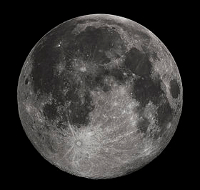
Throughout history, man has studied this familiar object in our sky. It figures prominently in the legends of every people group in the world. The twelve basic divisions in our calendar year—the months—have their origin in the Moon's period of revolution around the Earth. Among the ancient Hebrews, God used the New Moon—the phase of the Moon when it essentially disappears—to mark important events. And because of the close similarity in angular diameter of the Moon and the Sun as seen from Earth, we have the phenomenon of the solar eclipse when the Moon passes in front of the Sun. One of the earliest triumphs in observational astronomy was when ancient astronomers were able to accurately predict when eclipses would occur.
In more modern times, study of the Moon turned toward its physical characteristics. The Moon does rotate on its axis, but because it rotates once for every revolution around the Earth, it always keeps the same face toward us. This is called phase locking, and is common among natural satellites in our solar system. The Moon is essentially without atmosphere, having only an extremely tenuous envelope of mostly inert gases and vaporized sodium and potassium. Its face is heavily cratered, although the side facing Earth has large flat areas called maria, which is Latin for “seas”. These “seas”, however, contain no water, and are believed to be vast areas of solidified lava. Various theories have been proposed as to why they occur almost exclusively on the side facing Earth.
At one time, the Moon was thought to be completely dry and without water. Recent satellite observations have, however, revealed that there are large amounts of ice buried in craters near the south pole (and presumably the north pole as well, although observations have only been made of the south pole). Parties interested in eventual colonization of the Moon view this ice as a potential major resource to enable such colonies to survive.
Fiction and space art once pictured the Moon as being covered with fissures and sharp-pointed mountains. However, exploration has revealed a solid surface without any cracks or fissures, covered in rocks of various sizes, and with rounded hills and mountains.
The Moon is the only body in the solar system—indeed, the entire Universe—that has actually been visited by man. In July of 1969 the Apollo 11 lunar module landed on the surface of the Moon, carrying two astronauts, Neil Armstrong and Buzz Aldrin. Altough most thinking human beings knew better, there were those who thought that the lander would immediately sink into an immense pool of dust, or that the Moon would actually explode upon contact with human feet. Of course, none of this happened, and the success of the Apollo 11 mission is a well-known historical fact. Still, scientists had at least one other worry. In spite of the hostile, airless, ultraviolet-drenched environment, NASA officials were nevertheless concerned enough about possible contamination by alien organisms that the returning astronauts were put into quarantine for a period of time.
The successful Apollo 11 mission was eventually followed by six more attempts to land men on the Moon. Five of these succeeded, with a subsequent return in each case. The exception was Apollo 13, which suffered an accident (an exploding oxygen tank) on the outward journey. Fortunately, through ingenuity—and perhaps also God smiling down upon them?—they were able to return to Earth, even though they had to abort the lunar landing.
In addition to the Apollo missions, the Moon has been visited by numerous unmanned probes—flybys, orbiters and landers, as well as “crashers”, which impacted the surface destructively. Currently, there are a number of unmanned missions exploring the moon, from multiple countries—including a Chinese lander and rover on the far side.
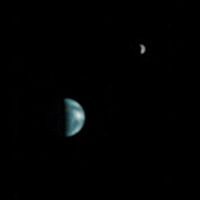
Earth and Moon seen from Mars orbit
by Mars Global Surveyor
Earth has been observed and studied by so many satellites that “space trash” is starting to become a hazard. However, some of the more interesting observations are those made by spacecraft not orbiting Earth. At least one view of Earth as an “evening star” in the Martian skies has been returned from surface landers. The Cassini probe orbiting Saturn has taken our picture. Several probes returning to use Earth for a gravitational assist to take them on to further targets have imaged our planet. But probably the most famous of all extraterrestrial shots of our world are those taken from the Moon.
Today, most satellites launched into Earth orbit serve purposes other than science. Communication and military satellites are among the most common. And the satellites that do look at Earth are usually there for the purpose of tracking weather or looking for minerals or other resources. Additionally, there is now a continuous manned presence in Earth orbit: the International Space Station.
And, of course, there are orbiting observatories such as the Hubble Space Telescope that are used to study the universe from a vantage point above the interference of the atmosphere. Without such hindrances as clouds and “seeing” (the blurring of an image due to turbulence in the atmosphere), telescopes can work twenty-four hours a day. The only inconvenience is servicing; entire Space Shuttle missions have been dedicated to repairs and upgrading on the Hubble Telescope.
Of all the planets in our solar system, Earth is the one that is “out of place”. It possesses physical characteristics that are very difficult to account for naturally, such as the presence of large quantities of oxygen in its atmosphere (oxygen is a reactive gas that would quickly combine with other elements and vanish, on a cosmic timescale). The presence of life is the greatest anomaly. The commonly accepted theory is that life arose as a result of natural processes over geologic time scales. However, a critical examination of the evidence reveals enormous flaws—including certain assumptions that violate basic laws of nature, such as the Second Law of Thermodynamics—which scientists have great difficulty in adequately explaining away. The alternative, of course is the theory of intelligent design. For more on this, see the pages on Life, the Universe and Everything and The World Around Us.
I personally find it fascinating to note that recent models of planetary formation predict an Earth surrounded by a dense atmosphere of mostly water vapor, carbon dioxide and nitrogen—such a world would be dark and covered in liquid water, which is amazingly similar to the way Genesis describes the world at the time of Creation. Coincidence?
Today, astronomers are engaged in searching for “another Earth”. To date, nearly two thousand extrasolar planets have been discovered. However, not one has yet been confirmed that is the same mass and size as Earth and at the right distance from its sun. Given the statistics of such planets, it is highly probable that such a planet will eventually be found. But my question is: Will it truly be Earth's twin? Or will it be more similar to the planet described in the previous paragraph? What you believe will largely depend on what you believe about the origin of life.
http://www.thebilliardpage.com/space/earth.shtml
Copyright © 2005-2026 William R. Penning. All rights reserved.